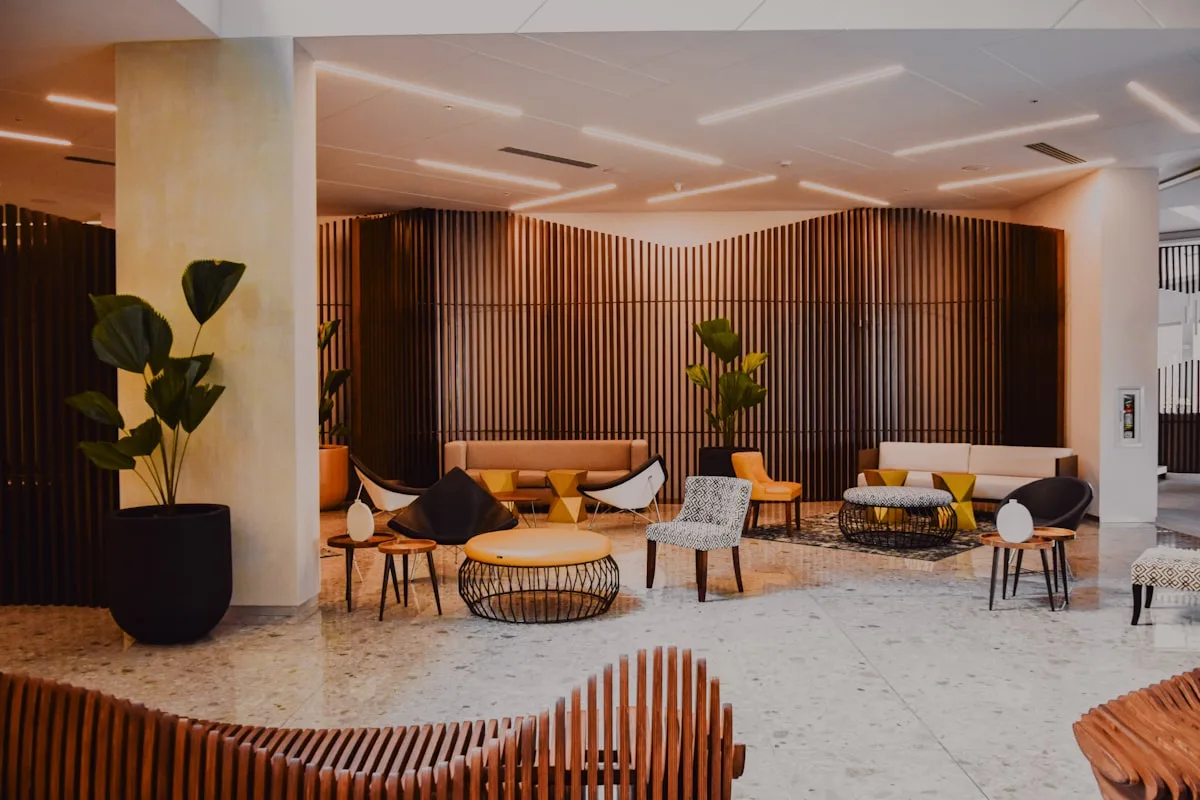
Greece is at the centre of a hospitality investment boom with no historical precedent. In 2024 alone, tourism sector investments exceeded five billion euros, with Attica, Crete, the Cyclades, and the Ionian Islands attracting international capital. Chains including Marriott, Accor, IHG, and Four Seasons are all expanding their Greek presence, while boutique five-star projects are emerging across the archipelago. Every one of these buildings carries a critical requirement that is routinely underestimated: electrical installations that are fundamentally different from any conventional commercial building.
A high-end hotel is not simply a building with more power outlets. It is an experience system — where lighting, temperature, security, and automation must function as a unified whole: silently, reliably, and with no compromise on quality.
1. Power Supply: Why Hotels Need a Private Substation
In a conventional commercial building, a low-voltage connection from the public grid is typically sufficient. In a high-specification hotel — particularly a resort with a spa, restaurants, swimming pools, and full air conditioning across hundreds of guestrooms — the required power demand frequently exceeds what the existing local grid infrastructure can supply.
Private Medium-Voltage Substation
Most upper-market hotels require a private medium-voltage substation (20kV) integrated into the building or located within the site perimeter. The substation typically consists of 20kV switchgear, a power transformer (usually 630kVA to 2,000kVA depending on scale), and a low-voltage main distribution panel.
Transformer sizing must be decided in Phase 1 of the design process, as it directly affects architectural space allocation and structural requirements.
Uninterruptible Power Supply (UPS) and Generator
In a hotel, a power outage is not a minor inconvenience — it is a crisis. UPS systems and diesel or gas generators are mandatory for:
- Fire detection and life safety systems (legal obligation under ELOT EN 60364 and EN 54)
- Emergency and evacuation lighting
- Telecommunications infrastructure (servers, PBX, check-in systems)
- Critical facilities (kitchen, refrigerated storage)
- Elevators and accessibility systems
2. DALI Lighting Control: The Standard for High-End Hotels
What DALI Is and Why It Became the Industry Standard
DALI (Digital Addressable Lighting Interface) is the internationally standardised protocol for digital communication between lighting control devices. It replaced analogue dimming systems (0-10V) and has become the de facto standard for every four-star and above hotel.
Unlike conventional systems, DALI offers:
- Individual addressing: every luminaire has a unique digital address
- Bidirectional communication: the system knows if a fixture is operating or has failed
- Scene programming and scheduling: automatic lighting scene changes by time of day, room use, or event type
- Energy monitoring: real-time consumption measurement per zone
- Full BMS integration via gateways (BACnet, KNX, Modbus)
DALI Applications by Hotel Space
Guestrooms and Suites: Programmable scenes (welcome, sleep, reading, cleaning) with warm CCT in the 2,700-3,000K range and CRI ≥ 90. Each room controlled independently or via central BMS.
Lobbies and Public Areas: Lighting scenes shift throughout the day, from bright energizing light in the morning to warm relaxing tones in the evening. Integration with building management platforms allows hotel operators to optimise energy use without compromising guest comfort.
Restaurants and Bars: Scene presets for breakfast, lunch, dinner, and special events. Instant atmosphere changes via tablet or central console without any rewiring.
Exterior and Facade: Grazing techniques for architectural feature highlighting, safety lighting for pathways and pool areas, integration with daylight sensors for automatic adjustment.
3. Hotel BMS: The Brain of the Building
What a Hotel BMS Controls
A Building Management System (BMS) is the central automation platform that coordinates all electromechanical systems within a hotel. In a high-end hotel, the BMS scope extends considerably beyond an office building:
- HVAC and Room Control: Per-room temperature management, automatic deactivation when a window opens or the guest departs (card reader integration)
- DALI Lighting Integration: DALI-to-BMS gateways for centralised control and energy analytics
- Access Control: Card readers, electronic locks, lobby barriers
- Energy Management: Real-time consumption monitoring, energy reporting, photovoltaic integration
- Elevators, Pools, Spa: Monitoring and automation of electromechanical plant
- PMS Integration: Connection to the hotel Property Management System for automatic room conditioning on check-in and reset on check-out
Protocols: KNX, BACnet, Modbus
For hotel projects, KNX is widely used for room automation in European projects, BACnet is preferred for HVAC integration in large resorts, and Modbus handles industrial plant including generators and pumps.
4. Fire Detection and Evacuation: Strict Requirements for High-Occupancy Environments
The EN 54 Standard and Hotel Requirements
Hotels are classified as high-complexity buildings with large concentrations of occupants who are unfamiliar with evacuation routes. In many European countries, hotels are required to have alarm and evacuation systems that comply with the EN 54 standard.
Core fire detection requirements for hotels:
- Addressable fire alarm system: every detector has a unique address for precise incident location
- Multi-sensor detection: combined smoke, heat, and flame sensors to minimise false alarms
- Voice evacuation system (EN 54-16/24): clear, intelligible emergency instructions — the system consists of an evacuation control center, amplifiers, certified loudspeakers, and monitoring systems
- Redundant power supply (EN 54-4): continuous operation during mains failure
- Emergency lighting integration: automatic activation during evacuation
5. Weak Current Infrastructure in Hotels: The Systems That Drive the Experience
Beyond power systems, high-end hotels require specialist weak current infrastructure:
- Structured cabling Cat6A/Fibre optic backbone for the hotel network
- VoIP/PBX telephony for internal communications and room service
- CCTV and Access Control — full coverage of public areas, zone-specific access categories
- Digital Signage and In-Room Entertainment — dedicated cabling for TV systems, IPTV, and guest tablets
- IoT and Video Door Entry — integration with BMS for a seamless smart room experience
Frequently Asked Questions
It depends on the total power demand. A resort with a spa, pools, restaurants, and full air conditioning typically exceeds the supply capacity of the low-voltage public grid. In these cases, a private 20kV medium-voltage substation is required. The calculation must be carried out in the [concept design phase](/en/blog/ilektrologos-fasi-melitis-kostos-argis-emplokhis) by the electrical engineer.
DALI enables individual addressing of every luminaire, scene programming by use and time, bidirectional fault monitoring, and energy consumption tracking. For hotels, it is not a luxury — it is a baseline requirement for the guest experience standards demanded by international brands.
In an office building, the BMS primarily manages HVAC and lighting. In a hotel, the BMS additionally integrates with the Property Management System, room control systems, access control, CCTV, voice evacuation, and real-time energy management. The complexity and reliability demands are substantially higher.
Electrical and electromechanical installations in a five-star hotel can represent 20-30% of total construction cost, compared with 10-15% for a conventional commercial building. The difference is driven primarily by BMS, DALI systems, private substation, UPS and generator, and full weak current infrastructure.
In Greece and across the EU, fire detection systems in hotels must comply with the EN 54 standard series. This covers detectors, control panels, power supply (EN 54-4), voice alarm control equipment (EN 54-16), and loudspeakers (EN 54-24). The overall electrical installation must also comply with ELOT EN 60364. Compliance with both standards is a prerequisite for operating licence approval.
Need a technical assessment for your project?
Get in touch